
Africa’s pursuit of lasting peace and security is not a new ambition. It is a commitment that African leaders have repeatedly placed at the centre of the continent’s development agenda.
On 25 May 2013, during the 50th Anniversary of the Organisation of African Unity (OAU) and the African Union (AU), African Heads of State and Government adopted a Solemn Declaration expressing their determination to achieve a conflict-free Africa. The declaration called for peace to become a reality for all Africans, an end to civil wars and conflicts, an end to human rights violations and humanitarian disasters, and the prevention of genocide.
Perhaps most importantly, African leaders pledged not to bequeath the burden of conflicts to the next generation and committed themselves to ending all wars on the continent by 2020.
This commitment became one of the foundations of the African Union’s Silencing the Guns initiative.
From the 2013 Commitment to Silencing the Guns
The idea of Silencing the Guns is closely connected to Agenda 2063: The Africa We Want, the African Union’s long-term framework for the continent’s transformation. https://www.peaceau.org/uploads/arusha-au-high-level-retreat-report-web.pdf
Agenda 2063’s Aspiration 4 envisions “A peaceful and secure Africa.” It calls for mechanisms for the peaceful prevention and resolution of conflicts to function at all levels and emphasizes dialogue-centred approaches to conflict prevention and resolution. It also recognizes the importance of nurturing a culture of peace and tolerance among Africa’s children and youth through peace education.
The AU’s Silencing the Guns initiative was therefore not designed simply as a call to stop armed fighting. It was connected to a broader vision of addressing the political, social, institutional and economic conditions that contribute to conflict and insecurity.
The African Union identifies the initiative as a flagship component of Agenda 2063 and links it to efforts to end wars and violent conflicts, prevent genocide, address gender-based violence and create conditions for sustainable peace and development.
The African Peace and Security Architecture
A major part of this vision is the African Peace and Security Architecture (APSA).
APSA provides the institutional framework through which the African Union and its regional partners work on conflict prevention, management and resolution. Its implementation includes mechanisms related to early warning, conflict prevention, mediation, peace support operations and post-conflict reconstruction.
The importance of APSA is reflected in Agenda 2063, which identifies a fully functional and operational APSA as one of the goals under Aspiration 4.
This means that Silencing the Guns requires more than responding after violence has already begun. It requires functioning institutions capable of identifying risks, preventing escalation, supporting dialogue, facilitating peace processes and helping societies recover after conflict.
It also requires cooperation between the African Union and Regional Economic Communities and Regional Mechanisms (RECs/RMs). Peace and security challenges frequently cross national borders, making coordination between continental, regional and national institutions essential.
The 2020 Target and the Road to 2030
Read more for the road Map https://au.int/sites/default/files/documents/38304-doc-1_au_roadmap_silencing_guns_2020_pdf_en.pdf
The original ambition was to silence the guns by 2020. However, the target was not fully achieved.
The African Union subsequently extended the implementation of the Master Roadmap on Silencing the Guns to 2030. The AU Assembly made this extension in 2020, and the 2023 Assembly reaffirmed the 2030 implementation period.
The extension recognizes that the causes and drivers of conflict are complex and that achieving sustainable peace requires long-term commitment.
The AU’s current framework continues to connect peace and security with governance, humanitarian assistance and development. In its August 2026 communiqué on revitalizing the Silencing the Guns Roadmap, the AU Peace and Security Council emphasized the links between peace, security, governance, humanitarian support and development.
The 2030 timeline therefore provides an opportunity to reassess what has been achieved, identify persistent gaps and strengthen implementation.
Why Do Conflicts Continue?
The challenges facing peace and security in Africa are diverse.
Conflicts can emerge or intensify in environments characterized by political exclusion, inequality, poverty, human rights violations, weak governance, marginalization, competition over resources, unresolved grievances and the manipulation of social or ethnic divisions.
The AU Peace and Security Council has previously emphasized the need to address underlying drivers of violent conflict, including marginalization, poverty, underdevelopment, youth unemployment, corruption and the mismanagement of natural resources.
This demonstrates why Silencing the Guns cannot be reduced to military or security responses alone.
Peace requires institutions that people can trust. It requires opportunities for young people. It requires dialogue between communities. It requires respect for human rights and the rule of law. It requires mechanisms that can address grievances before they become violent.
Military Coups and Political Instability
Another important dimension of Africa’s contemporary peace and security environment is the recurrence of military coups and unconstitutional changes of government.
Political instability can create additional challenges for peacebuilding, governance and regional stability. It can also complicate efforts to establish sustainable institutions and democratic processes.
For this reason, discussions about Silencing the Guns must also consider the relationship between peace, security and governance.
The goal is not simply to prevent armed conflict between groups. It is also to create political and institutional conditions in which disputes can be managed through constitutional, peaceful and democratic mechanisms rather than through violence.
Emerging Security Threats
Africa’s security environment is also changing.
In addition to conventional armed conflicts, countries and communities face threats associated with violent extremism, terrorism, organized crime, the proliferation of small arms and light weapons, cyber-related risks, displacement, climate-related pressures and other emerging challenges.
These threats can interact with existing political, economic and social vulnerabilities.
This is why the African Union’s peace and security agenda increasingly recognizes the need for approaches that connect security, governance, humanitarian action and development rather than treating each issue separately.
Young People and the Culture of Peace
Silencing the Guns is also about the future generation.
Agenda 2063 recognizes that a culture of peace and tolerance must be nurtured among Africa’s children and youth through peace education.
This is particularly important because young Africans are not simply affected by conflict; they are also important participants in peacebuilding, community development and social transformation.
Investing in peace education, leadership, dialogue, employment, civic participation and opportunities for young people can contribute to building communities where violence is less likely to become the primary means of resolving disagreements.
A peaceful Africa therefore requires not only stronger institutions, but also citizens who understand the value of dialogue, inclusion, tolerance and peaceful conflict resolution.
What Does Silencing the Guns Mean Today?
The phrase “Silencing the Guns” can sometimes sound like a simple call to stop the use of weapons.
But the broader AU framework presents a much larger vision.
Silencing the Guns means working toward a continent where conflicts are prevented before they become violent, disputes are resolved through dialogue, communities are protected, human rights are respected, and institutions are capable of responding to threats to peace and security.
It means addressing the conditions that allow violence to emerge in the first place.
It also means recognizing that peace is not achieved once and then permanently secured. Peace must be built, protected and renewed.
From 2020 to 2030: What More Can Be Done?
The failure to achieve the original 2020 target does not remove the importance of the commitment. Instead, it raises important questions about implementation.
What lessons can Africa learn from the past decade?
How can early warning systems become more effective?
How can African institutions strengthen conflict prevention?
How can communities and civil society participate more meaningfully in peacebuilding?
How can young people become active participants in peace and security?
How can governments and regional institutions respond to unconstitutional changes of government and emerging security threats?
And, most importantly, how can Africa move from commitments and frameworks to stronger implementation on the ground?
These questions are particularly relevant as the African Union continues its efforts to revitalize the Silencing the Guns Roadmap toward 2030. In August 2026, the AU Peace and Security Council held a dedicated meeting on progress in the implementation of the roadmap and its revitalization.
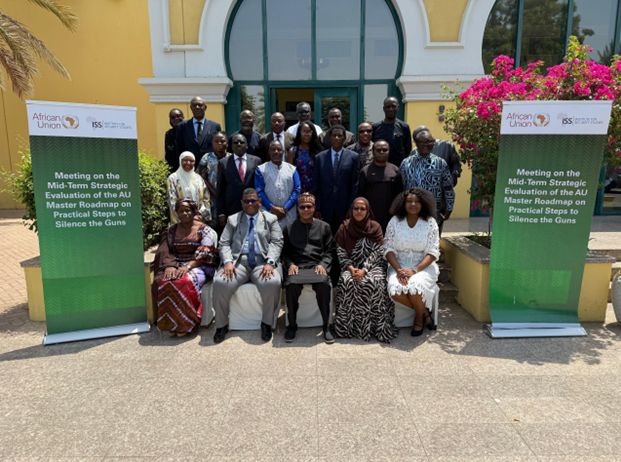
Source: The Meeting on Mid-Term Strategic Evaluation of the AU Master Roadmap of Practical Steps to Silence the Guns in Africa by the Year 2030 concludes in Djibou
Wem’Afrika’s Conversation on Silencing the Guns
As part of the International Day of Peace on 21 September, Wem’Afrika is bringing these issues into conversation through a webinar titled:
“Silencing the Guns in Africa: Responding to Armed Conflicts, Military Coups & Emerging Security Threats”
The webinar will provide an opportunity to reflect on Africa’s peace and security challenges and discuss possible pathways forward.
The conversation will explore:
- Armed conflicts and their impact on African communities
- Military coups and political instability
- Emerging security threats
- Conflict prevention and peacebuilding
- The role of young people and civil society
- Peace, governance and human security
- Strengthening dialogue and social cohesion
- The way forward for Africa’s Silencing the Guns agenda
For Wem’Afrika, peace and security are not issues that belong only to governments or international institutions. Communities, civil society organizations, young people, women, educators, researchers and other stakeholders all have a role to play.
The Way Forward
The commitment made by African leaders in 2013 remains significant: Africa should not pass the burden of war and conflict to another generation.
The extension of the Silencing the Guns agenda to 2030 provides another opportunity to strengthen the continent’s peace and security mechanisms and to translate commitments into action.
Achieving a peaceful and secure Africa will require sustained political commitment, stronger institutions, regional cooperation, inclusive governance, conflict prevention, peace education and meaningful participation from communities.
Silencing the guns is therefore not only about ending the sound of weapons.
It is about creating societies where dialogue can replace violence, inclusion can reduce exclusion, institutions can protect people, and peace can become a shared responsibility.
As Africa continues its journey toward 2030, the question is not only whether the guns can be silenced.
The question is also:
What kind of Africa do we build after the guns are silent?
Wem’Afrika — Yes! My Africa.
Source: www.accord.org.za
Source: https://au.int/